


BLOG
We go all in!
Brand Architecture
Brand Architecture is an important strategic process in Brand Development. Brand Architecture, simply put, is the relationship between various Brands in an Organisation. It defines how should two Brands be related or be completely unrelated. Brand Architecture informs how should each Brand behave, how should they talk, what should they believe in and how do they Visually Express themselves. It maximises Visibility of every Brand in the Portfolio.

Brand Architecture is an important strategic process in Brand Development. Brand Architecture, simply put, is the relationship between various Brands in an Organisation. It defines how should two Brands be related or be completely unrelated. Brand Architecture informs how should each Brand behave, how should they talk, what should they believe in and how do they Visually Express themselves. It maximises Visibility of every Brand in the Portfolio.

Whether you are establishing your first Brand, or you’re big enough to Merge/Acquire another company or have grown to be Multi-Million Dollar Business with several Brands, Brand Architecture is important to you.
Scenario 1: You are starting your first business
Consider you are a budding Entrepreneur and have plans to start a new fine-dine Restaurant in the coming months. Subsequently, you also have plans to start a Sports Bar and a Themed Cafe.
A. You decide that all these 3 businesses should run as ONE Brand. They should all be built on same Values, have same Brand Name, Logo and Visual Style. Great. You will save on Marketing Expenditure and can leverage the Equity of already existing Brand Name. But, if you deliberate a little more, you’ll realise that all the three businesses will cater to different set of customers.
B. Hence, you may want to consider option B, where you’ll give each business its own unique Identity, unique Brand Name, Logo and Visual Style. Well, there are demerits of doing so as well. You’ll have to establish each of the Brands from the beginning. Investing so much of time and money may not be worth it. Here is where a Branding Agency comes in. By systematically analysing multiple parameters, you’ll be recommended if all or none of the future businesses should carry existing legacy.
Scenario 2: Your existing business is successful. Now, time for a new business. Or perhaps, a merger or an acquisition.
In such situations, Brand Architecture Strategy can help you in three ways:
1. Avoids Cannibalisation:
BMW 3 series doesn’t cannibalise sales of 5 Series because they are meant for different Customer Profiles. If you’re sporty and young, you’d go for the 3; and if you’re more of an Executive Class who is mostly chauffeured around, you know the 5 Series is your choice. This takes us to our second point.
2. Clarifies offerings:
Brand Architecture bring order and clarity to the portfolio. It can help Customers differentiate between two products of the same company (House of Brands) or it can help them identify two Brands of the same company (Branded House). This also helps Customers choose what they want. It is easier to decide between MacBook Air and MacBook Pro, as compared to two windows computers from HP.
3. Optimises expenses:
A clear and easy to understand Brand Portfolio helps Brand Owners to optimise Marketing spends on each Brand and control Management expenses that otherwise would have been out of proportions.
About The Brand Meridian Model:
The Brand Meridian Model is our Proprietary Tool that solves most complex Portfolio issues to help maximise business resources. It irons our any anomalies in the Portfolio whilst also optimising and leveraging Brand Equity. You can learn more about The Brand Meridian Model by writing to us.
Read more about Brand Architecture here.
If cars were people...
We love cars. A lot. We stare at them and they stare back at us. This may be Pareidolia, but we love to find meaning. Today, we've decoded some of our favorite cars and their distinct front character. Did you know that most car designers think this way before they start the sketch?...

We love cars. A lot. We stare at them and they stare back at us. This may be Pareidolia, but we love to find meaning. Today, we've decoded some of our favorite cars and their distinct front character. Did you know that most car designers think this way before they start the sketch?
Below are some of the most expressive cars. If you don't see human faces in the cars below, try squinting your eye, go far from the screen, keep staring at the 2D drawing.
Audi TT Coupe - Aggressive

BMW 5 Series - Proud

Chevrolet Cruze - Grumpy

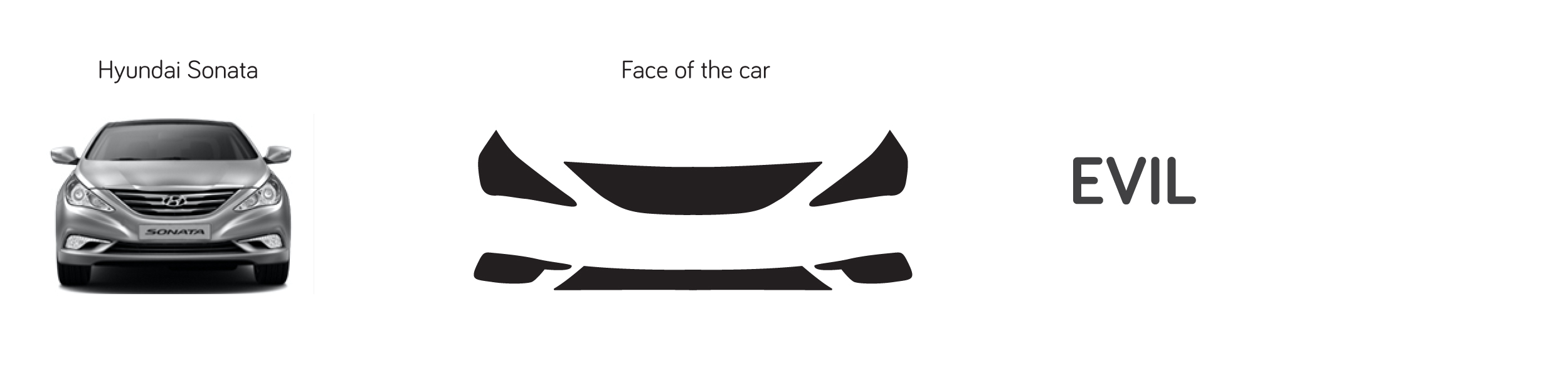
Hyundai Sonata - Evil
Mercedes S Class Coupe - Serious

Skoda Octavia - Content

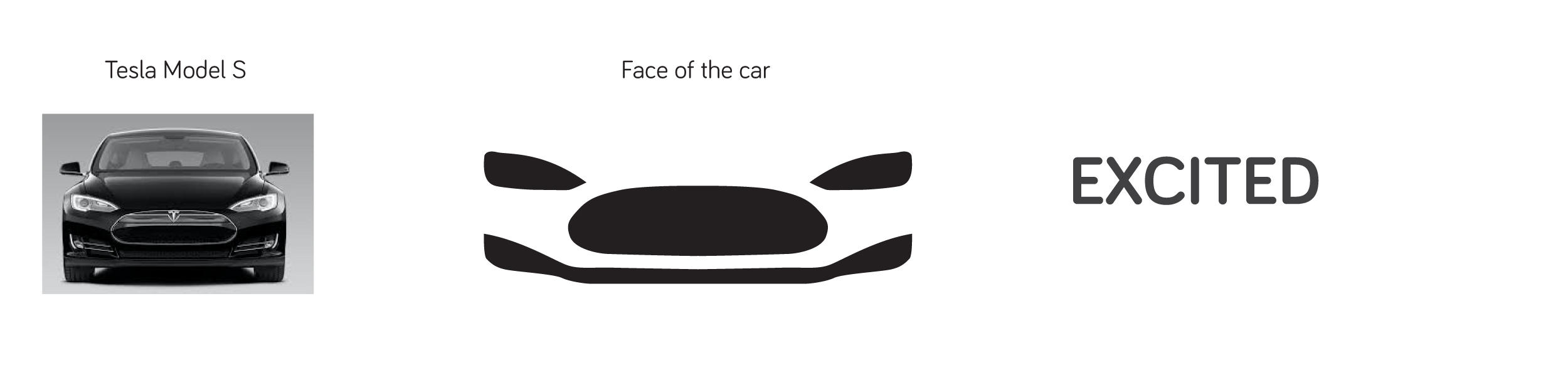
Tesla Model S - Excited
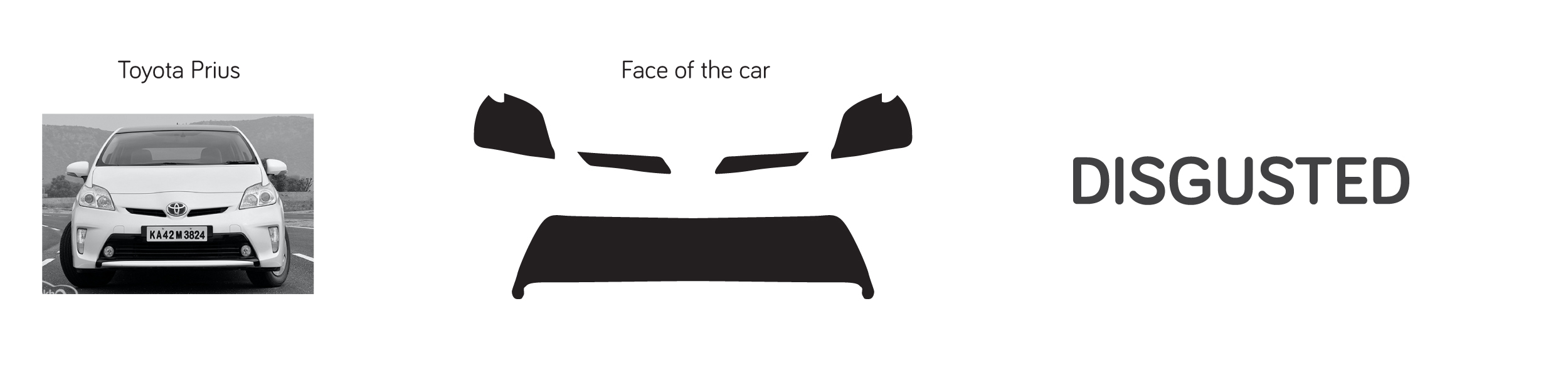
Toyota Prius - Disgusted
Types of Logos & their Uses
Broadly there are 3 types of logos. Before getting into that, let us take you through the fundamentals first.
Importance of Logo in your brand identity: A logo is the most important element of a brand's visual identity. It defines who you are and builds image of your brand. Believe it or not, human brains can sub-consciously determine whether to trust a company or not, just by looking at its logo...

Broadly there are 3 types of logos. Before getting into that, let us take you through the fundamentals first.
Importance of Logo in your brand identity
A Logo is the most important element of a Brand's Visual Identity. It defines who you are and builds image of your Brand. Believe it or not, Human Brains can sub-consciously determine whether to trust a company or not, just by looking at its Logo. This happens in the Limbic System of our Brain. A finely crafted & confident Logo can help create intended Brand Image and also create affinity.
A Logo is the simplest and most powerful tool of recall. And that's how we recognise Brands too. It has direct impact on a Brand's Recognition and its Recall. Brand Recognition & Brand Recall are important components of Brand Equity. A strong Logo and Brand Identity can actually increase the monetary value of your Brand.
Key pointers to bear in mind while you get your Logo designed
A. Keep it Simple: Keep the Logo simple and effective. Let it communicate everything in least possible strokes, lines and highlights. Get rid of the bevels, shadows, 3D effect, gradients and vignettes if they don't add any visual meaning to the Logo. Avoid stylish fonts that may hamper legibility of the Brand Name. The simpler the Logo, the more effective will be the Brand Identity. It is easier to recall Nike's Logo compared to Alfa Romeo's.
B. Make it Timeless: A Logo shouldn't be created following any trend or popular rendition style. Logos should be relevant for at least 5 years. It must reflect your business values. A Logo created on whims and fancies is merely an art. The Colour Palette and choice of Fonts should be defined by the values of the Brand.
C. Make it Scalable: All Logos should be designed with scalability in mind. Do consider future JVs and sub-brands - how will those be placed should they appear in future. You will also need to consider various applications of the Logo. It will appear as a favicon of 16 pixels and on large surfaces like billboards. It should look good on all applications.
D. Make it Meaningful: There is no merit in creating a Graphic Element that doesn't mean anything. Your Logo should mean something to you and to your Customers. Use Colours that evoke right feelings. Use fonts that project right Brand Image.
Okay, so now that we have covered the importance of logo and the DOs of creating an effective one, let's dive into the types of logos.
1. Typographic logo

Such logos are made up of simple typography without any significant graphics. It is preferred that you customise an existing font to create such Logos. Disclaimer: Never use an existing font as is. Give unique character to it. Examples: Facebook, Disney, Absolut, FedEx, Google & Visa.
2. Combination logo

Majority of Logos in the world fall under this category. These logos have graphical element beside the Symbol or within the Symbol. Examples: Taco Bell, Puma, Harley Davidson, NBA, WWF & MasterCard.
3. Symbolic logo

Such Logos have a symbol with no text. They start out as a Combination Logo. When the Brand becomes popular and known enough, they can drop the text and keep only the Symbol representing the Logo. Popular car brands are known for doing this, like Volkswagen. Twitter, Apple and Starbucks are the most popular examples here. Even Yellow Fishes' logo falls in this category.
Disclaimer: Your Brand will be able to sustain this Logo type only when
i) Your offerings are very different from the competition, and
ii) You've stayed with Combination Logo for long enough for your Customers to identify you with the Symbol only
Bonus
We appreciate you for reading this and we have 2 bonus points for you.
1. Ambigram: A logo that can be seen/read in exact same way from opposite directions. Yellow Fishes' logo is an ambigram- i.e. it will be read as same YF from two opposite directions. An ambigram logo can be made in Typographic, Symbolic or Combination Logos.
2. You can't please everyone with your Logo. Ask people for their opinions but keep the Brand Values as the lynchpin.
Convergence vs Divergence
Is technology bringing us together or drifting us apart?
When was the last time you checked your phone? And when was the last time you hugged your sibling? We are living in the information era, that is proliferating with new technologies more than ever. We now know what is happening in the lives of our friend-of-friend more than the lives of our cousin. Isn't that bizarre?...

Is technology bringing us together or drifting us apart?
When was the last time you checked your phone? And when was the last time you hugged your sibling? We are living in the information era, that is proliferating with new technologies more than ever. We now know what is happening in the lives of our friend-of-friend more than the lives of our cousin. Isn't that bizarre?
We think the technology is creating invisible boundaries of personal preferences, instead of knitting us together. We read our text messages more than the speed limits while driving. We are listening to the hashtags on social media more curiously than the brainstorming session we are at. What could be the reason for this irrational behaviour? Let's cut open this and understand the real impulses behind this.
1. Power
We all agree that internet is power in our hands. Phones and tablets are great tools to connect us with the world. Now, when someone says this is a 7 star hotel, you can choose not to believe it and a little bit of research will tell you the answer. We aren't dependant on what's being telecasted on the TV. We have our Netflix, Apple TV and Youtube. We aren't dependant on what's being aired on radio. We can listen to our favourite genre of music, whenever we like it- thanks to Internet radio. In a way, technology is enabling us to define our own rules. It is allowing us to consume content we like, generate the content we like and share when we like.
2. Recognition
This is not circa 1999 when only people who appreciated us were our parents and school teacher. Ah, wait one second. My phone just popped an Instagram notification... Okay, so as it turns out, a follower just liked and commented on a post saying 'he loved it'. You see, this is called instant gratification. When you push out value, the world will appreciate and recognise you. And, we see the same on all social platforms.
3. The need to appear busy
Phones, tablets and now smart watches too are great 'personal tools for distraction'. We can take a phone call or make one, and escape a discussion we don't want to be part of. We see notifications popping all around us. How can one be perceived so free in life? While everyone is into their phones, let me also check my stream.
4. Social animal
We are social creatures and we depend on one another for everything. We make new connections everyday. But, you know there is nothing that feels better than connecting with an old friend.
Okay, so all said and done. We are inattentive to people around us to make stronger connection with someone 3000 miles away. Perhaps, we are still going to be like this for the next century. If you see a pattern here , all the impulses to do so are because it makes two people feel good. We're going to give you a little advice here. Notifications in your phone can wait. Make the person in front of you feel good, now. Give your undivided attention to your clients, friends, and family. Ignore all the notifications, while you are with them. We bet they will feel good. They will feel special. Try it for yourself you will see them smiling.
Brand Expansion - How to make a local brand global?
If you're reading this, our best guess is that your brand is doing well. Congratulations! And probably you're ready to grow outside the Geographical Limits - moving to another city, state, country or continent. This goes without saying that before finalising your next business location, you should have enough Customer and Market Understanding. And once you've finalised the location, you should be taking the following steps to make your brand a success in new markets.
If you're reading this, our best guess is that your brand is doing well. Congratulations! And probably you're ready to grow outside the Geographical Limits - moving to another city, state, country or continent. This goes without saying that before finalising your next business location, you should have enough Customer and Market Understanding. And once you've finalised the location, you should be taking the following steps to make your brand a success in new markets.
1. Standardisation and Consistency
When you're expanding to new geographies, the most important thing is standardisation of Brand Experience. It doesn't matter whether you're a Retail Champion, a Restauranteur, a Fashion Label Owner, or a Service Provider. You stand for something today and you've spent time and energy in getting there. When you expand to new location, your Brand should continue to stand for the same Promise. Have the same taste in your Restaurant, same fragrance, lighting and ambience in your retail store, and same Business Values, Ethics and Principles. This is critically important and hence it is Numero Uno on our list.
2. Localisation Strategy
While expanding, staying consistent and bringing in Brand's own legacy is important. But, Brands should also adapt themselves to the local markets. This is best implemented in the Food Industry. Mc Donalds remodels and alters its menu for each country. Starbucks couldn't sell lot of coffee in China (because it is a tea-loving country). This led them to create a menu specific for that country - with loads of tea on offer. This applies to you too - no matter what your business.
This may appear dichotomous. Hire a Branding Expert to strike the right balance between "what to continue" and "what to change". In India, "Bata" - the Footwear Retail Brand is perceived so Indian, that now we have hard time believing it is an international brand, that too from Europe. Hyper-Localisation can ruin the Brand Imagery. And so does Franchise Model without strict Guidelines. Here, an outsider's POV is paramount. Branding agencies have best understanding of market and customers. Write to us if you're looking at entering Asian markets.
3. Distribution and Reach
Distribution is important for Product Brands. For a Product Brand to be successful, it needs to have significant reach in the new Geography. Customers should be aware of the Brand, what it offers and how it is different. So, in addition to the robust Supply Chain Management, you should also have good Communication Budget to announce your entry into the Market. You could do this with extensive Social Media Engagements also.
4. Research and Penetration
Once you're in the new market, you should continue to Research on the Trends, Beliefs, Aspirations of the new Market. The impulses & triggers to purchase a Product or buy into a Brand differs every 250 miles. When you introduce a Product specifically for new Markets, the Consumers are pleased. We often see this in car Market when country-specific Models are launched. They are very often successful, and are based on their Research and understanding of the Market needs. But, you could do it in any Category. Leverage your Brand, capitalise on your strengths and live upto your Brand Promise.
Recession and Brand Building — Put the pedal to the metal, when everyone else slows down.
In a car race championship, if you're trailing behind and want to win the race, what do you think you can do? Nope, accelerating won't help, because you're already pushing your car to its limits and so are all others. So, how will you win? Well, you can. Read on to find out how...
In a car race championship, if you're trailing behind and want to win the race, what do you think you can do? Nope, accelerating won't help, because you're already pushing your car to its limits and so are all others. So, how will you win? Well, you can. Read on to find out how.
Drawing a parallel to the business world, perhaps you have strong growth plans but the competition is doing better than you. Your company is hustling every day, your teams are giving in all they have got and your competition is still ahead. So, how will your Brand win? Wish there was Nitro in real world too.
If you want to take the lead and win in the car race, the only opportunity you have are the corners of the circuit — where every one will slow down. You too, have to slow down, but accelerate harder and quicker than others. That's your only chance. Don't miss it.
In business, if you want to be the industry leader, or start a new business — NOW IS THE TIME. Use this economic slowdown to your advantage. Everyone else around you is slowing down. Go Zag, when the world goes Zig. While they cut down on expenses with layoffs, you should be brainstorming on your next move, invest in Branding (the best time to do it), scale up your digital presence, revamp your website, build strong customer relations, plan diversification and international expansion of your business.
If you’re like us, you’ve always prided yourself on a particular process and/or a certain way of doing things. We immensely respect your commitment to who you are and how you work. But, unique circumstances demand unique responses. Don’t be afraid to adapt your perspective, shift processes, offer online ordering, and refocus on how your business can maintain cash flow and build momentum for the future. Who knows? You may find a new, profitable revenue stream as you adapt and shift your business that you can take with you long into the future.
The worst thing you can do is panic right now. Remember what got you here. Rest easy in that, while we don’t know how long things will be this way, it is temporary and there is a return to normalcy at the end of the tunnel. Understandably, we’re all refocusing and shifting to survive and sustain something none of us have really faced before. No one has all the answers, and “figuring this out” looks very different for each of us — but don’t panic. Take things in stride. Be open to change and new ideas. Be flexible with what you may have to do to sustain and thrive in the near term so you can sprint out of the gate when things return to normal.
Our only request is DON’T SLOW DOWN! Put the pedal to the metal. This is your only chance, until the next recession.
What does it take to be an entrepreneur?
"Everyone can be an entrepreneur. But very few truly are.”
To be an entrepreneur you need not have: - Money - Place to set up your office - A large team - Enough job experience Surprised? Don’t be.
If not these, then what do you need to be an entrepreneur?...

"Everyone can be an entrepreneur. But very few truly are.”
To be an entrepreneur you need not have: - Money - Place to set up your office - A large team - Enough job experience Surprised? Don’t be.
If not these, then what do you need to be an entrepreneur?
1. You need courage. And you must be full of courage. You should be willing to hustle every day of the year. Period.
2. Self-Motivation & Perseverance. No matter what the world thinks about your business- if you love it, keep going.
3. Trust your gut. This is a big one. Your gut will talk to you often - listen to it and act wisely. If you feel butterflies at 3AM just fantasising about your business - you will succeed.
4. Adaptability & Flexibility. Be willing to adapt. Be agile. Don’t overthink. If you make a mistake, accept and move to the second best alternative. You will hit quite a few walls in your entrepreneurial career, and its okay. Everyone does. Don’t be bogged down. Keep moving. Hustle. And lastly, “Don’t be afraid to start small. Every great company was once small, confined within a room."
Brand Association - Why do we associate with a Brand?
When you interact with products, be it your morning coffee to what phone are you using, how do you feel about it? You walk into a Starbucks for coffee or own an iPhone is because you want to be associated with these brands. They make you feel in a certain way. You trust them and its image appeals to you, it matches or exceeds your expectations and it doesn’t let you down...

When you interact with products, be it your morning coffee to what phone are you using, how do you feel about it? You walk into a Starbucks for coffee or own an iPhone is because you want to be associated with these Brands. They make you feel in a certain way. You trust them and its image appeals to you, it matches or exceeds your expectations and it doesn’t let you down.
Brand Association refers to particular impressions a Consumer has about the Brand. These impressions are imprinted by the marketers in our minds using associations that are memorable and strong. This helps one Brand differentiate from other competing Brands. To my mind, Samsung has a stronger association with colour Blue, even stronger than Microsoft. These associations take shape over a period of time by all forms of communication like Advertising, Promotions, and more. It is the Brand Image that differentiates one Brand from another in the eyes of the Consumer. Brand Image is the overall impression in Consumer’s mind that is formed from various associations. Brand Association is not a factor of Sales or Market Share, but it sure is a factor of memorability or Brand Recall, like they say. For example, some feel Apple's MacBook is a better brand as it exceeds expectations. On the other hand, some feel Samsung is a better Brand as it is simple and affordable. They both appeal to different mindsets. And appropriate Associations are pushed by the Brands to appeal to right Benefit Groups. While both the Brands appeal best to its Consumer Classes equally- which is a better Brand remains debatable. When a Consumer buys a Product or a Service, s/he is not only paying for the Product or Service but is also paying for the Brand Image and how s/he associates her/himself with the Brand.
I associate with Burberry Body perfume as it gives me the sense of exclusivity and it carries an elite image. The fragrance is just different from any regular one. May be its just my perception. But, I feel so.
Ask yourself, why do you associate with your favourite Brand?
Article contributed by - Ashni Shah, Marketing Team, Yellow Fishes
Two Paradoxes of Brand Rejuvenation
Brand rejuvenation is a fabulous thing. But, it has a few caveats.
Here are the two paradox of brand rejuvenation…
Brand rejuvenation is a fabulous thing. But, it has a few caveats.
Here are the two paradox of Brand Rejuvenation:
1. The more popular a Brand, the more difficult it is to change and hence minimal Changes are done to its Expression.
2. The more the Change is needed by the Consumers, the more it is ridiculed when the Change appears.
Do you need a Branding Agency?
You may wonder why does your company need a branding agency? You are doing just about fine, or better you could be surpassing expectations. So, why fix something when it is not broken? You shouldn’t. But, remember branding is as much about building as it is about fixing...
You may wonder why does your company need a Branding Agency? You are doing just about fine, or better you could be surpassing expectations. So, why fix something when it is not broken? You shouldn’t. But, remember Branding is as much about building as it is about fixing.
You may be wondering that you have an in-house Design team or a pool of freelancers who can do a fair job, so why hire a Branding Agency? Well, Design is not a commodity, nor is Branding done on whims. Brands are built on Promises and Experiences (the whole wide world of Branding can be deciphered in these two words)- you need to Identify what your Brand is Promising to its Customers or what it can/should Promise and then translate that Promise Visually and Verbally into Brand Experiences across touchpoints.
A Branding Agency understands your Customers better. You may have Marketing mavericks who are well travelled and have multifarious background but they are in most cases restricted by their own views of Marketing Strategy and Aesthetics. Branding Agencies specialise in defining the Core of your Brand and translating them into Brand touchpoints. A Branding Agency sees your Brand in ensemble, beyond a deliverable like Identity Design, Positioning, Communication Design or Verbal Identity.
You must talk to a Branding Agency about your company’s Branding if:
1. Your company is an SME and have big Aspirations
2. Your BHAG is daunting
3. You want to grow your Market or Market Share
4. You want to build a stronger Brand
5. You have a superior Product or Service but your Customers don’t know about it
6. You're growing and want to perceived differently
7. The vision of the Brand has evolved and matured
8. You have just started your business, or starting up
We’d love to hear from you, please write in to us hello@yellowfishes.com
Brand strategy is the key to effective marketing.
Branding preceeds all marketing and communication. Infact, defining a brand should be the first step in any marketing strategy. To define a brand, a branding agency needs to study and understand the market dynamics, category trends and consumer behaviour...
Branding defines. Marketing communicates.
Branding preceeds all Marketing and Communication. Infact, defining a Brand should be the first step in any Marketing strategy. To define a Brand, a Branding Agency needs to study and understand the Market Dynamics, Category Trends and Consumer Behaviour. Once the Agency is acquainted with the Dynamics, the next step is Analysis of the Data and closer look at the Competition to see what they are doing best and what are the learnings. Brand Positioning is not about identifying an empty spot in the Market and pitching in the Brand there, it’s about owning one-something that your Brand can stand for and leveraging that. The next step is translating the Brand Positioning and Proposition into Visual Language and Verbal Language of the Brand. Hereafter, it’s a two-pronged Approach. One is to maintain Consistency in Visual and Verbal Languages (for Recall and Recognition) and the Second is to create enough Variations in Visual and Verbal languages so there is no monotony in the Marketing of your Brand.
What is a brand? What is branding?
‘Brand’ is perhaps the most overused word in today’s marketing & business vocabulary. You will most likely agree when I say that a brand is any product or service that is trademarked and/or is differentiated from its competition by virtue of name, symbol etc. Great! You are not wrong, but not completely right either. That is what ‘brand’ meant about 50 years ago, or may be 75 years!...
What is a brand? What is branding?
‘Brand’ is perhaps the most overused word in today’s marketing & business vocabulary. You will most likely agree when I say that a brand is any product or service that is trademarked and/or is differentiated from its competition by virtue of name, symbol etc. Great! You are not wrong, but not completely right either. That is what ‘brand’ meant about 50 years ago, or may be 75 years!
Today, in this ever changing world amidst liberalisation and globalisation, there is more competition for every company than ever before. That means there is more need for marketing. Companies are deploying their push and pull strategies to get maximum customer base. The customers that we are talking about are discerning, well-traveled and extremely conscious about his/her choice. How can that customer be tricked into a marketing gimmick? Or a fancy advertisement campaign? 50 years ago, a trademarked name was enough to make the purchase decision, or at least induce purchase behaviour. Today, even a unique value proposition may not be enough to inspire purchase. Every trademarked company (read brand) is talking about what it has to offer and how its products meet the needs. So, effectively in today’s world- every company has a value proposition that they want to talk about- some big, some small, some rational, some emotional. Thereby, everyone ends up talking the same language, confusing the customers even more – ”I have salt in my toothpaste, other says- I have sodium, third says- I have potassium chloride.” The companies may think they have differentiated offerings, but the truth is none of those offerings are remembered (poor recall and poor recognition) because all of them talk the same language. They are all fighting for ingredients, or in other words functional RTBs.
We can talk about 10 different things a brand has to offer but only one such thing is remembered. Every brand today needs to stand for one-something, and they have to communicate that effectively and live by it. In simpler words, the word ‘brand’ can be deciphered in two words:
1) Promise and 2) Experience.
Brands are not built on whims or competitive behaviour, they are built on values. You will only be able to keep such a promise that is true to you. If you overpromise- you will doom your brand. All advertisements are great, but they only increase awareness and seldom inspire any action. Branding determines what is to be communicated. Branding therefore is the art (more than aesthetics) and science (not rocket-science) of identifying that one-something. It is the belief, it is the core, it is your brand’s purpose built on value system of your company that will steer your organisation for the years to come.
Today, branding is not placing your logo on every touch point. It is the art of determining how can you visually and verbally translate brand’s core promise and use it across touch points in order to gain recall, recognition, awareness, et al and all other parameters that make a brand stronger.
Get Branded!